
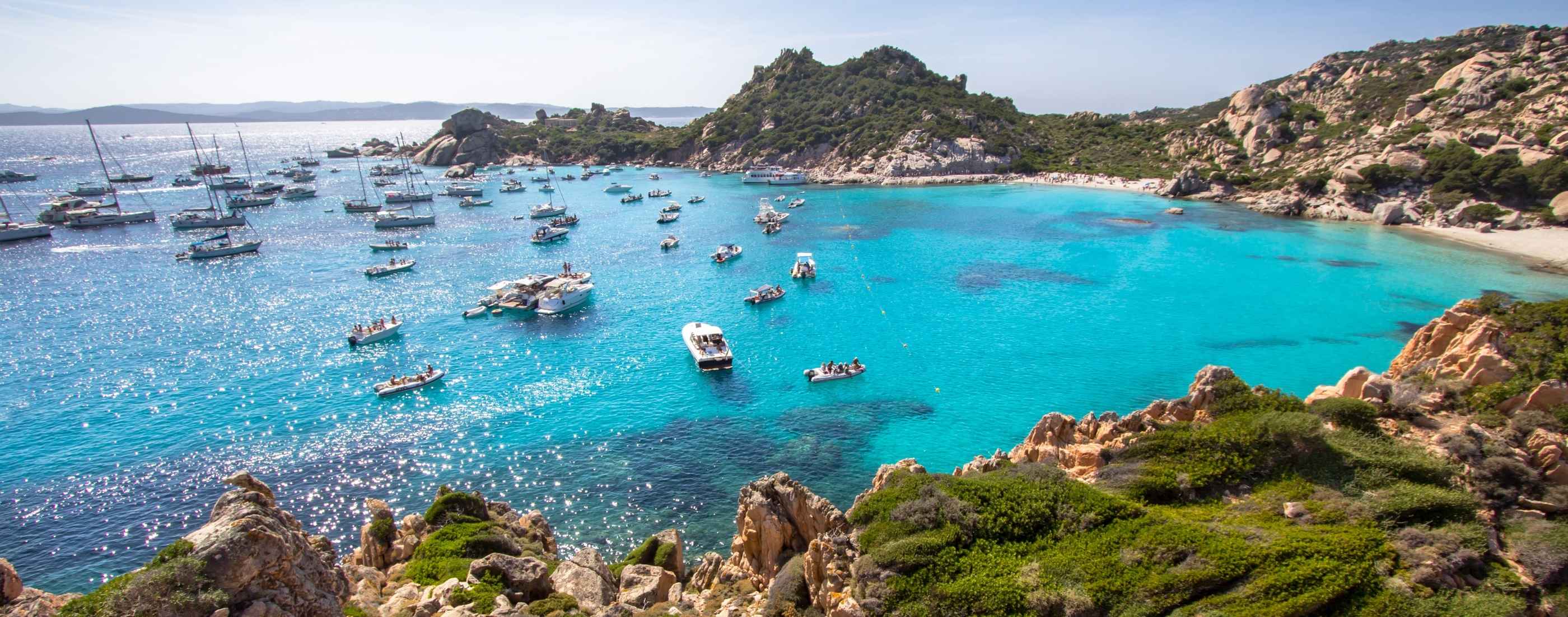
Classical Sardinia
Tour Introduction
Sardinia boasts one of Europe’s richest and most captivating archaeological landscapes. The island has seen Phoenicians, Greeks, Carthaginians, Romans, Arabs and Catalonians come and go. Before them, the mysterious Nuraghi people left over 7000 weird and wonderful stone structures which pepper this seductive landscape. This 7-night and 8-day tour explores fabulous Greco-Roman towns, stunning rock-cut tombs and corbelled towers, impressive giant statues of warriors, ancient pyramidal structures and mysterious Tophet cemeteries to bring you the best of the island’s intriguing past.
Highlights
- Explore the rich archaeological legacy of the island’s multilayered past including Nuraghic, Phoenician, Greek and Roman remains
- Visit the spectacular ‘giant tombs’ of the Nuraghic people at S'Ena'e Thomes
- Admire a remarkable Nuraghic site of Sa Sedda’e Sos Carros in a 4x4 excursion
- Wander the Punic-Roman cities of Nora and Tharros in their stunning coastal settings
- Visit the extraordinary prehistoric pyramid pf Monte d’Accoddi, unique in Europe
- Explore the rich archaeological collections at Cagliari and Cabras Archaeology Museums, the latter housing the famed stone giants of Mont’e Prama
- Ponder the mystery surrounding the island’s Tophet cemeteries and their dark possibilities
Interested in this tour but not ready to book? Register your interest using the link below and we will keep you updated on the progress of the tour.
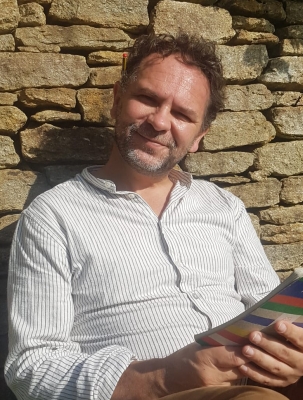
Dr Farès K Moussa
Farès is an anthropologist, archaeologist and consultant in heritage and arts/culture management, with a particular expertise in North African, Saharan and central Mediterranean Phoenicio-Punic, Amazigh (‘Berber’), Nuraghic (Sardinia) and Roman archaeology, as well as contemporary ‘folk’ Islamic practices. His portfolio career over the last twenty-five years has included numerous archaeological survey, excavation and heritage impact mitigation projects in the MENA region and Europe; and Directorships in several arts/culture organisations in the UK. He has been leading and lecturing on archaeological tours since 2006.
Farès read Anthropology and Psychology at the University of East London, Archaeology at University College London and University of Edinburgh; and was Marie Curie Fellow in the History of Thought at the École normale supérieure (Paris). He is particularly interested in the relationships people develop with material and visual culture, especially in ‘religious’ contexts; and how different human perceptions and understanding of the world are determined. He has several journal and chapter publications and is currently writing his first book based on his thesis (University of Southampton) about how human cognition underlies different types of relationship to material culture.
Background
Sardinia - known to the Greeks as Sandaliotis (“the sandal”) and Ichnoussa (“the stepping stone”) - has been forged by a remarkable roll-call of cultures: Phoenician traders, Greek settlers, Carthaginian merchants, Roman administrators, Arab navigators and Catalonian rulers.
Long before any of them arrived, the enigmatic Bronze Age Nuraghi people left their mark in the form of more than 7,000 striking stone monuments scattered across the island’s idyllic hills.
Among Sardinia’s most compelling sites are Europe’s only known pyramidal structure from the late Neolithic; extraordinary sacred wells carved in an inverted pyramid form; rock cut tombs adorned with paintings and engravings - nicknamed “fairies’ houses”; the iconic Nuraghi towers; imposing stone statues of warriors and archers; and the controversial Punic Tophet burial grounds.
As we wander through hidden passages inside corbelled towers and study the impressive bronzettis of proud warriors, a tantalising question lingers: could the Nuraghi have been the same horned helmeted Shardana, the “Sea Peoples” who - according to Egyptian letters and reliefs from the 14th and 13th centuries BC - raided the Levantine coast?
What's Included
- 4 Star Hotels
- Dedicated Tour Manager
- Helpful and friendly travel advice
- Meals as indicated in the itinerary
- Return flights from London (optional)
- The company of like-minded travelers
- Tour information booklet
- Access to the Cultural Experience app
Day 1: Arrival
Day 1: Arrival
Fly from London to Cagliari airport and transfer to our hotel or if making your own travel arrangements meet us at the hotel. Hotel in Orosei region for 2 nights. Due to the late arrival at the hotel, there will be no dinner this evening.
Day 2: Nuraghic rituals - Sa Sedda'e Sos Carros
Day 2: Nuraghic rituals - Sa Sedda'e Sos Carros
We start our tour at the excellent museum of Nuoro which will set the area’s discoveries in context. The highlight of the collection are the fabulous collection of bronzes discovered at sites in the region. Continuing into the distinctive limestone Supramonte region we use 4x4 vehicles to ascend to the remarkable 3500-year-old late Neolithic/Nuraghic complex of Sa Sedda’e Sos Carros, including an elaborate enclosed fountain surrounded with bench seating, thought to be a ritual building. (B, D)
Day 3: Giant tombs and sacred springs
Day 3: Giant tombs and sacred springs
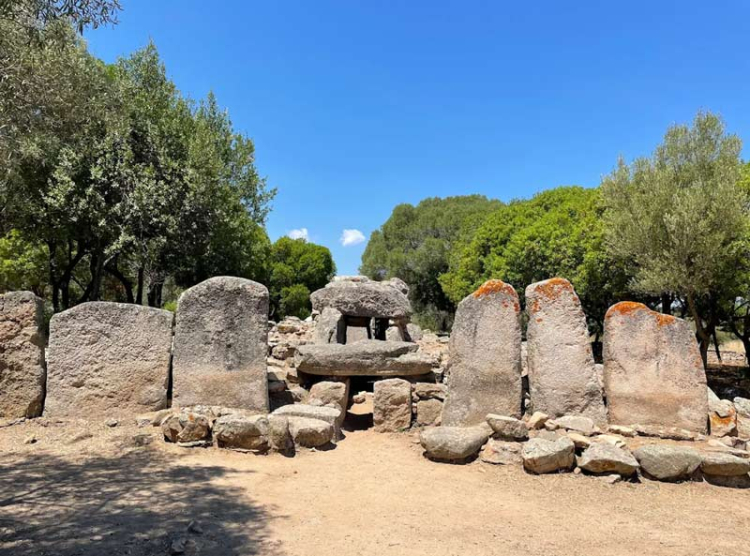
Today we start at the Giants’ tomb of S'Ena'e Thomes, built between 1500 and 1200 BC, where we admire the monolithic dolmen structure archetypal of prehistoric Sardinian funerary architecture. Our journey continues to the Nuraghic village of Romanzesu-Poddi Arvu: stretching over 7 hectares in a cork wood this site includes temple buildings, a “sacred well”, small proto-amphitheatre and mysterious spiral building. We move to Su Tempiesu where a short walk through woodland takes us to the unique 3500-year-old sacred spring where we admire the exquisite opus isodomum stonework technique. Continuing westward we stop at the hypogeal necropolis known as ‘domus de Janas’ (“fairies houses”) at Sas Concas before continuing to the beautiful coastal city of Alghero. Hotel in Alghero – 3 nights. (B,D)
Day 4: A Sardinian pyramid
Day 4: A Sardinian pyramid
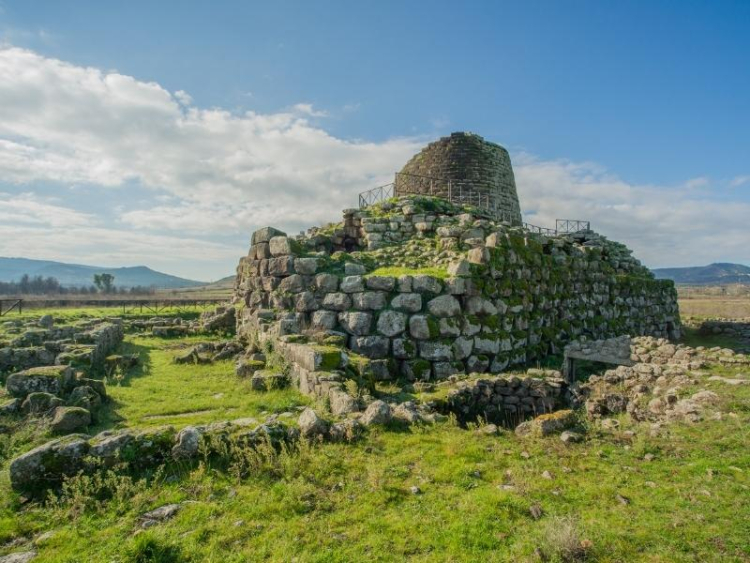
We visit the extraordinary prehistoric pyramid of Monte d’Accoddi - the only one of its kind in Europe – and not unlike a compact Mesopotamian ziggurat. Constructed by the pre-Nuraghic Ozieri culture after 4000 BC it is thought to have been a major animal sacrifice site. Continuing to Santu-Antine we admire a well-preserved Nuraghic tower - one of the best examples of its kind – and at Nuraghe Palmavera view one of the most important sites in Mediterranean megalithic culture. Return to Alghero where there is time to wander and explore this lovely town. (B, D)
Day 5: Nuraghic ingenuity
Day 5: Nuraghic ingenuity
Embarking again into the rugged Sardinian landscape we visit a trio of fantastic sites in the archaeologically rich Marghine region which further demonstrate the ingenuity and imagination of the Nuraghic peoples. At Losa we admire the Nuraghic beehive shaped tholos tomb and at the prehistoric complex of Tamuli we marvel at the famous bi-occular (or double breasted) standing “betyls”, elongated anthropomorphic cones. We return to Alghero via the extraordinary and mysterious inverse pyramid-shaped Nuraghi “sacred well” of Santa Cristina. (B, D)
Day 6: Tharros and the stone giants of Mont'e Prama
Day 6: Tharros and the stone giants of Mont'e Prama
A morning spent exploring the Punic and later Roman settlement of Tharros on the scenic Sinis peninsula. Like Nora the city passed from Carthaginian to Roman hands and the presence of a Tophet deepens the mystery surrounding these cultic sites. We also visit the nearby Cabras museum to see the remainder of the stone Giants of Mont'e Prama possibly dating from as early as the 11th century BC. Apart from the mesmerising stylised form of these giant statues of warriors, archers and boxers these may be the earliest known anthropomorphic statues in the Mediterranean outside of Egypt. Continue to Cagliari. Hotel in Cagliari or area for 3 nights. (B, D)
Day 7: Nora and Cagliari Archaeology Museum
Day 7: Nora and Cagliari Archaeology Museum
Visit the extensive Punic-Roman city of Nora, built on an isthmus in a truly stunning maritime setting. With its origins as a Nuraghic settlement the city grew into a Phoenician then Carthaginian emporium before its conquest by the Romans in 238 BC. Here we admire several fine mosaics, thermal baths and a Roman theatre. Return to Cagliari to visit to the National Archaeological Museum with its extensive collection of prehistoric objects including fine bronze Nuraghic statuettes. (B, D)
Day 8: The mystery of Tophet
Day 8: The mystery of Tophet
Drive west to the Sant’antioco archipelago via an isthmus and visit the ancient Phoenician-Punic “Tophet” site of Sulcis, then a second “Tophet” cemetery at Monte-Sirai. At these sites we consider a disturbing and controversial question: did Punic civilisation practice infanticide? Drive to Cagliari Airport where the tour ends unless you are returning with us to London. (B)