
From the Mongolian Steppe to Beijing's Forbidden City
In the realm of the Great Khans
Tour Introduction
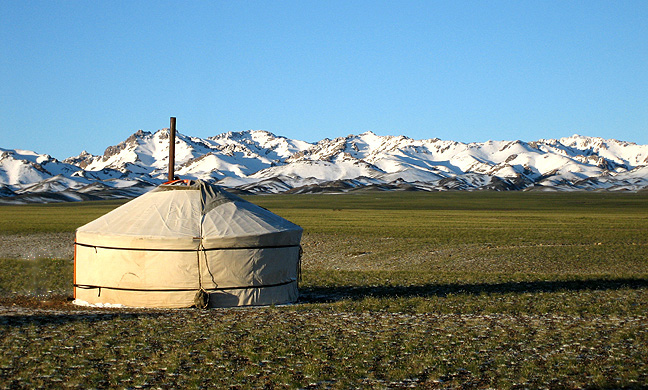
This tour takes us through the vast steppes, limitless horizons and robust personality of Mongolia and northern China as we explore the lands of the Khans. Genghis and his grandson Kublai, one a gritty horseback warrior, the other the founder of an opulent Chinese dynasty marked by extravagance and sophistication, both have left an indelible mark on Asian history. Travelling from Mongolia’s capital Ulaan Bataar we explore a landscape Genghis would have known so well including the Tereli National Park and the ancient Imperial Capital at Karakorum. The tour also allows us to marvel over the rich Buddhist heritage of this incredible country at such sites as the Gandantegchinlen and Erdene Zuu monasteries. We also admire the unique nomadic culture of the steppes and sample the warm hospitality of local people in their gers (tents), an experience not to be missed. Crossing into China we visit Ordos, centre of the modern cult of Genghis, and the ‘blue city’ of Hohhot, capital of Inner Mongolia where Mongolian culture is strongly preserved. Our tour finishes in Beijing where we admire the legacy of the Yuan Dynasty including the Forbidden City, built exactly on the site of the Great Kublai Khan’s palace.
Background
Sometime in the 1160s a child was born into the Mongolian Borjigin clan who was to change the face of Asia, from China to the Black Sea and beyond. Legend has it that the baby was born clutching a blood clot in his hand, an indication that he would become a warrior. Known as Temüjin he grew into a powerful leader who through a mixture of ruthlessness, deft political manoeuvring, and sheer dogged determination, came to dominate the Mongolian steppe. In 1206 he adopted the title Genghis Khan, thought to mean ‘Universal Ruler’, and within a few years had invaded the territory of the Tangut empire of north-central China. In 1215 he captured Zhongdu, capital of the Jin Dynasty, known today as Beijing. By his death in 1227 he had conquered large swathes of Western Asia: the blood clot prediction had come true.
Kublai Khan (1215-1294), Genghis’s grandson, carried the Mongol empire into a new era. He completed the conquest of China and founded the Yuan Dynasty in 1271, becoming the first non Han emperor to rule all of China. Kublai focused on administration, trade, and cultural exchange, welcoming foreign visitors like Marco Polo to his capital at Dadu (Beijing). While Genghis forged the empire through conquest, Kublai strengthened it through governance and innovation.